
How AI Is Rewriting Cybersecurity (and Why Attackers Are Winning)
AI cybersecurity tools reduce breach detection from hours to minutes. 8 platforms compared, with pricing, implementation guidance, and honest limitations.
• AI-powered cybersecurity tools reduce mean detection time from hours to minutes by analyzing billions of events in real time
• The top platforms (CrowdStrike, Darktrace, Vectra AI, Splunk) use machine learning to detect novel threats that signature-based tools miss
• Attackers are using AI too — automated phishing, deepfake social engineering, and AI-generated malware are growing fast
• Most organizations need an AI-augmented SIEM, not a complete platform replacement — start with what you have
• The skills gap matters more than the tool: 3.5 million cybersecurity positions remain unfilled worldwide
What's Inside
- Why Traditional Security Tools Are Falling Behind
- How AI Changes Threat Detection
- The 8 AI Cybersecurity Tools Worth Evaluating
- The Other Side: How Attackers Use AI
- Implementation: Where to Start
- What This Costs in Practice
- What AI Can't Do (Yet)
- FAQ
Why Traditional Security Tools Are Falling Behind
The math problem in cybersecurity is simple and unsolvable by humans alone: enterprise networks generate millions of security events per day. A mid-size company's SIEM might ingest 10,000-50,000 events per second. Even the most skilled analyst can review perhaps 50-100 alerts per day in depth. The workforce shortage makes this worse — there simply aren't enough security professionals to keep up manually. Traditional rule-based systems generate thousands of alerts, most of which are false positives. Security analysts spend 80% of their time triaging alerts that turn out to be nothing.
Meanwhile, attackers are getting faster. The average time from initial access to lateral movement dropped to under 90 minutes in 2025, according to CrowdStrike's Global Threat Report. Signature-based detection — matching known attack patterns — catches threats that have been seen before. It misses zero-days, living-off-the-land attacks, and novel techniques by definition.
This is where AI changes the equation. Machine learning models trained on billions of security events can establish behavioral baselines for every user, device, and application on a network. When something deviates from that baseline — a finance employee suddenly accessing engineering repositories at 3 AM, a server making unusual outbound connections — the AI flags it before a human would notice.
The shift isn't theoretical. Organizations using AI-powered security tools report 108 fewer days to identify and contain breaches compared to those without, and average breach costs $1.76 million lower, according to IBM's 2025 Cost of a Data Breach report.
How AI Changes Threat Detection
Behavioral Analysis vs Signature Matching
Traditional tools ask: "Does this match a known attack pattern?" AI tools ask: "Is this behavior normal for this entity?" The difference is fundamental.
A signature-based system won't flag an admin account accessing a database because admin accounts are supposed to access databases. An AI system that has learned this particular admin account only accesses databases during business hours, from a specific IP range, querying specific tables, will flag a 2 AM access from a new IP running unusual queries — even though every individual action is technically authorized.
Automated Triage and Correlation
AI-powered SIEMs don't just detect anomalies — they correlate them across data sources. A failed login attempt alone is noise. A failed login followed by a successful login from a different country, followed by privilege escalation, followed by data exfiltration — that's a kill chain. AI models recognize these multi-step patterns across logs, network traffic, and endpoint telemetry simultaneously.
The practical result: instead of thousands of individual alerts, security teams get dozens of pre-investigated incidents with context, severity scores, and recommended response actions. Analysts go from drowning in alerts to making decisions.
Predictive Threat Intelligence
The most advanced AI security platforms now predict attacks before they happen by analyzing threat actor behavior patterns, vulnerability exploit timelines, and industry-specific targeting trends. This isn't science fiction — it's pattern recognition at scale applied to the threat landscape.
The 8 AI Cybersecurity Tools Worth Evaluating
• AI-powered cybersecurity tools reduce mean detection time from hours to minutes by analyzing billions of events in real time
• The top platforms (CrowdStrike, Darktrace, Vectra AI, Splunk) use machine learning to detect novel threats that signature-based tools miss
• Attackers are using AI too — automated phishing, deepfake social engineering, and AI-generated malware are growing fast
• Most organizations need an AI-augmented SIEM, not a complete platform replacement — start with what you have
• The skills gap matters more than the tool: 3.5 million cybersecurity positions remain unfilled worldwide
What's Inside
- Why Traditional Security Tools Are Falling Behind
- How AI Changes Threat Detection
- The 8 AI Cybersecurity Tools Worth Evaluating
- The Other Side: How Attackers Use AI
- Implementation: Where to Start
- What This Costs in Practice
- What AI Can't Do (Yet)
- FAQ
Why Traditional Security Tools Are Falling Behind
The math problem in cybersecurity is simple and unsolvable by humans alone: enterprise networks generate millions of security events per day. A mid-size company's SIEM might ingest 10,000-50,000 events per second. Even the most skilled analyst can review perhaps 50-100 alerts per day in depth. The workforce shortage makes this worse — there simply aren't enough security professionals to keep up manually. Traditional rule-based systems generate thousands of alerts, most of which are false positives. Security analysts spend 80% of their time triaging alerts that turn out to be nothing.
Meanwhile, attackers are getting faster. The average time from initial access to lateral movement dropped to under 90 minutes in 2025, according to CrowdStrike's Global Threat Report. Signature-based detection — matching known attack patterns — catches threats that have been seen before. It misses zero-days, living-off-the-land attacks, and novel techniques by definition.
This is where AI changes the equation. Machine learning models trained on billions of security events can establish behavioral baselines for every user, device, and application on a network. When something deviates from that baseline — a finance employee suddenly accessing engineering repositories at 3 AM, a server making unusual outbound connections — the AI flags it before a human would notice.
The shift isn't theoretical. Organizations using AI-powered security tools report 108 fewer days to identify and contain breaches compared to those without, and average breach costs $1.76 million lower, according to IBM's 2025 Cost of a Data Breach report.
How AI Changes Threat Detection
Behavioral Analysis vs Signature Matching
Traditional tools ask: "Does this match a known attack pattern?" AI tools ask: "Is this behavior normal for this entity?" The difference is fundamental.
A signature-based system won't flag an admin account accessing a database because admin accounts are supposed to access databases. An AI system that has learned this particular admin account only accesses databases during business hours, from a specific IP range, querying specific tables, will flag a 2 AM access from a new IP running unusual queries — even though every individual action is technically authorized.
Automated Triage and Correlation
AI-powered SIEMs don't just detect anomalies — they correlate them across data sources. A failed login attempt alone is noise. A failed login followed by a successful login from a different country, followed by privilege escalation, followed by data exfiltration — that's a kill chain. AI models recognize these multi-step patterns across logs, network traffic, and endpoint telemetry simultaneously.
The practical result: instead of thousands of individual alerts, security teams get dozens of pre-investigated incidents with context, severity scores, and recommended response actions. Analysts go from drowning in alerts to making decisions.
Predictive Threat Intelligence
The most advanced AI security platforms now predict attacks before they happen by analyzing threat actor behavior patterns, vulnerability exploit timelines, and industry-specific targeting trends. This isn't science fiction — it's pattern recognition at scale applied to the threat landscape.
The 8 AI Cybersecurity Tools Worth Evaluating
| Tool | Primary Strength | Best For | Starting Price |
|---|---|---|---|
| CrowdStrike Falcon | Endpoint detection (EDR) | Enterprises needing endpoint + cloud protection | ~$8/endpoint/mo |
| Darktrace | Self-learning AI, novel threat detection | Organizations with complex, evolving networks | Custom pricing |
| Vectra AI | Network detection (NDR) | Detecting lateral movement and insider threats | Custom pricing |
| Splunk Enterprise Security | SIEM with AI analytics | Large organizations with existing Splunk infrastructure | ~$150/GB/day ingested |
| SentinelOne Singularity | Autonomous endpoint response | Teams wanting automated remediation | ~$6/endpoint/mo |
| Palo Alto Cortex XSIAM | AI-driven SOC platform | Replacing traditional SIEM + SOAR stack | Custom pricing |
| Microsoft Sentinel | Cloud-native SIEM | Microsoft/Azure environments | ~$2.46/GB ingested |
| Anomali | Threat intelligence platform | Enriching existing security tools with threat intel | Custom pricing |
Related Reading
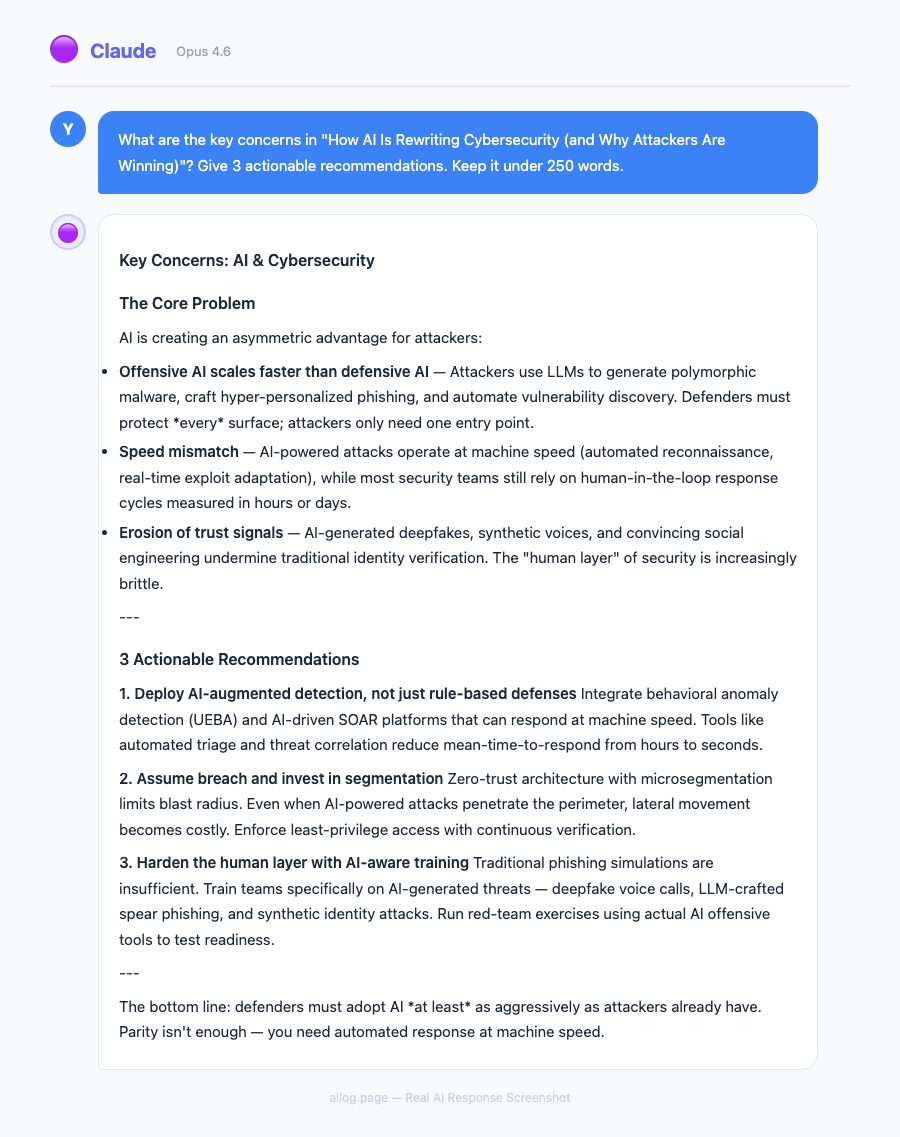
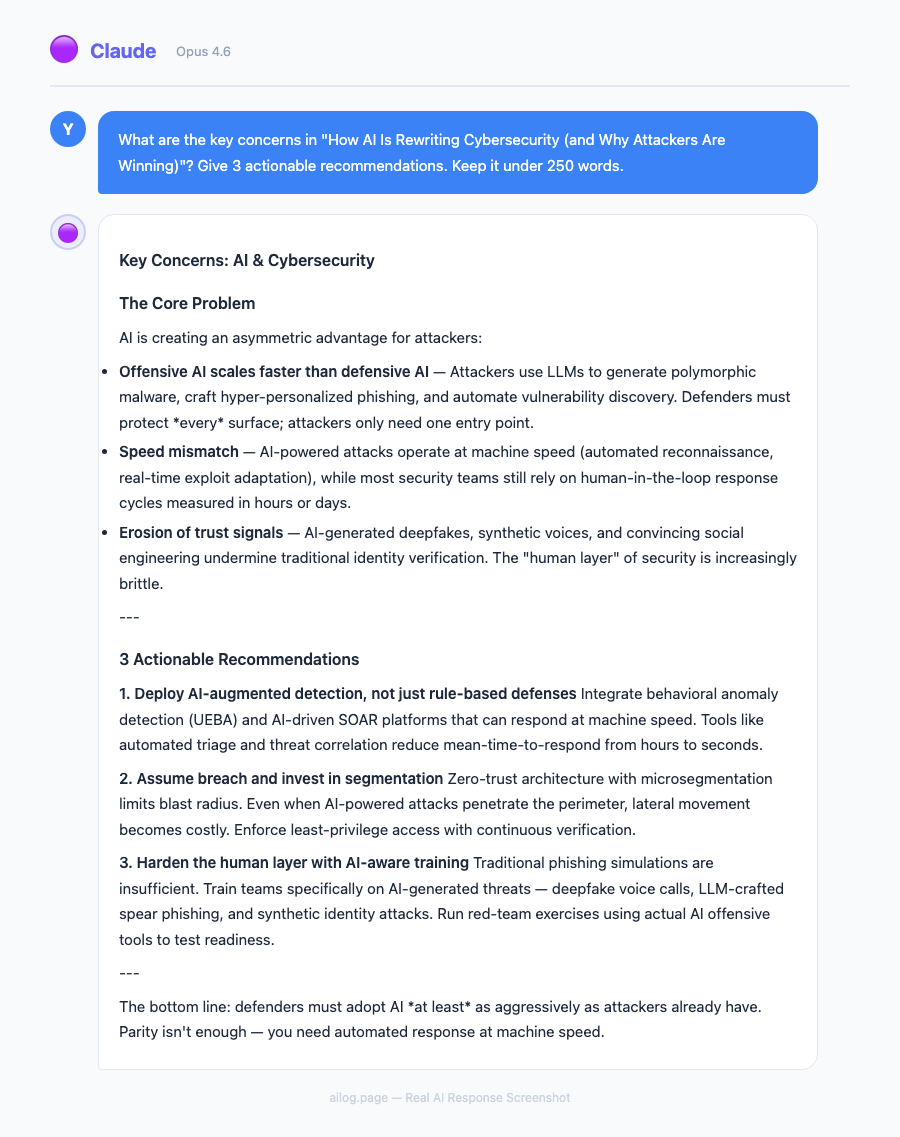
Real AI Responses (Tested March 2026)
CrowdStrike Falcon
CrowdStrike's models are trained on trillions of security events weekly from their massive customer base. The cloud-native architecture means new threat intelligence is distributed to all customers immediately — when CrowdStrike detects a new attack technique at one customer, every other customer benefits within minutes. Their Falcon Complete managed service adds 24/7 human analysts backed by AI, suitable for organizations without a dedicated SOC.
Darktrace
Darktrace's differentiator is unsupervised learning. Most security AI requires labeled training data (known attacks). Darktrace's models learn what "normal" looks like for your specific environment without being told what to look for. This makes it particularly effective against novel attacks that have never been seen before — including AI-generated threats. The Antigena module can autonomously contain threats by slowing or blocking suspicious connections in real time.
Vectra AI
Named a Leader in Gartner's 2025 Magic Quadrant for Network Detection and Response, Vectra analyzes network metadata rather than packet payloads. This approach detects encrypted threats (most enterprise traffic is encrypted) and focuses on behaviors — lateral movement, privilege escalation, command-and-control communication — rather than content. Particularly strong for detecting insider threats and advanced persistent threats (APTs).
Splunk Enterprise Security
Splunk's 2025 update split into Essentials (traditional SIEM) and Premier (advanced AI-driven TDIR). The Premier tier includes agentic AI that automates investigation workflows, SOAR automation for response playbooks, and UEBA (User and Entity Behavior Analytics) that profiles normal behavior patterns. Best suited for organizations already invested in the Splunk platform who want to add AI capabilities incrementally.
The Other Side: How Attackers Use AI
The uncomfortable truth: attackers have access to the same AI tools as defenders.
- AI-generated phishing: Large language models produce convincing, personalized phishing emails that bypass traditional content filters. Grammar and style that used to be a telltale sign of phishing are now flawless.
- Deepfake social engineering: Voice cloning and video deepfakes are being used in business email compromise attacks. A CFO's voice can be cloned from a few minutes of public speaking footage.
- Automated vulnerability discovery: AI tools scan codebases and networks for exploitable vulnerabilities faster than human researchers, reducing the window between vulnerability discovery and exploitation.
- Evasion techniques: AI-generated malware can mutate its code to evade signature-based detection, requiring behavioral AI on the defense side to keep up.
This creates an arms race where AI-powered defense isn't optional — it's necessary because the threats are AI-powered too. Organizations still relying entirely on rule-based security are increasingly outmatched. The rise of AI agents adds another dimension — autonomous AI systems that can probe networks, chain exploits, and adapt tactics in real time without human direction.
Implementation: Where to Start
You don't need to rip and replace your entire security stack. The most effective approach is adding AI capabilities to what you already have:
- Audit your current tools: Most modern SIEMs (Splunk, Sentinel, Elastic) already have ML features you might not be using. Enable them first.
- Add NDR for network visibility: Vectra or Darktrace alongside your existing SIEM provides a new detection layer without replacing anything.
- Upgrade endpoint protection: If you're still running traditional antivirus, switching to CrowdStrike or SentinelOne is the single highest-impact change.
- Implement UEBA: User behavior analytics catches insider threats and compromised credentials that perimeter defenses miss entirely.
- Automate response for known patterns: SOAR playbooks that automatically isolate compromised endpoints, block malicious IPs, and reset credentials for known attack patterns reduce response time from hours to seconds.
What This Costs in Practice
Small Business (50 endpoints)$500-1,500per monthEDR + basic SIEM. Managed service recommended.Mid-Market (500 endpoints)$5K-15Kper monthEDR + SIEM + NDR. Internal SOC analyst + vendor support.Enterprise (5,000+ endpoints)$50K-200K+per monthFull stack: EDR + SIEM + NDR + SOAR + TIP. Dedicated SOC team.
These costs look significant until you compare them to breach costs. IBM's data shows the average breach costs $4.88 million in 2025. A $180,000/year investment in AI security tools is cheap insurance against a single incident that could cost 25x more.
What AI Can't Do (Yet)
AI security tools aren't magic. Important limitations:
- False positives still exist: AI reduces false positives by 70-90% compared to rule-based systems, but doesn't eliminate them. Someone still needs to review flagged incidents.
- Training data bias: Models trained primarily on certain network environments may perform poorly in environments with different characteristics. Fine-tuning to your specific environment takes weeks to months.
- Adversarial attacks on the AI itself: Sophisticated attackers can slowly shift "normal" behavior to train the AI that malicious activity is benign — a technique called "boiling the frog."
- Compliance gaps: AI-generated security decisions may not satisfy regulatory requirements for human oversight in certain industries (healthcare, finance, government).
- The skills gap: AI tools still need skilled operators. The 3.5 million unfilled cybersecurity positions worldwide mean many organizations lack the expertise to properly deploy and manage AI security platforms.
The most effective security operations combine AI automation for speed with human judgment for nuance. AI handles the 95% of events that follow recognizable patterns. Humans handle the 5% that require creative thinking, business context, and risk judgment that AI can't yet provide.
There's also a transparency problem. Many AI security tools operate as black boxes — they flag threats but don't explain why. For security analysts who need to investigate incidents, understand attack chains, and report findings to management, a detection without explanation is only marginally more useful than no detection at all. The best platforms (CrowdStrike and Vectra in particular) provide detailed reasoning for their alerts, showing the specific behaviors and data points that triggered the detection. Others simply say "high risk" and leave the analyst to figure out why.
Finally, AI security tools require continuous feeding. Their effectiveness depends on the quality and breadth of data they receive. An AI tool monitoring only endpoint logs will miss network-level attacks. One that only sees network traffic will miss endpoint compromises. Comprehensive visibility across endpoints, network, cloud, identity, and email is necessary for AI to deliver on its promise — and achieving that visibility is itself a major infrastructure project.
FAQ
Can AI prevent all cyberattacks?
No. AI significantly improves detection speed and coverage, but determined attackers with sufficient resources can still find gaps. AI is best understood as a force multiplier for security teams, not a replacement for a comprehensive security program including employee training, access controls, and incident response planning.
Which AI cybersecurity tool is best for small businesses?
CrowdStrike Falcon Go or SentinelOne Singularity Core, both offering endpoint protection with AI-powered threat detection starting around $6-8 per endpoint per month. Pair with Microsoft Sentinel (free tier available for small Azure deployments) for basic SIEM. Managed detection services like CrowdStrike Falcon Complete add 24/7 monitoring without needing in-house security staff.
How long does it take for AI security tools to become effective?
Most AI security platforms need 2-4 weeks of baseline learning to understand normal network behavior. During this period, expect higher false positive rates. Full effectiveness, where the AI reliably distinguishes between normal anomalies and genuine threats, typically takes 1-3 months of tuning.
Do I need to replace my existing SIEM?
Usually not. Most AI security tools are designed to layer on top of existing infrastructure. Vectra AI, Darktrace, and Anomali integrate with major SIEMs via APIs and standard log formats. Start by adding AI capabilities to your current stack before considering a full platform replacement.
How does AI cybersecurity relate to the EU AI Act?
AI-powered security tools used in law enforcement and critical infrastructure are classified as high-risk under the EU AI Act, requiring documentation, human oversight, and risk assessments. Commercial security tools used by private companies face fewer restrictions but should still maintain audit trails and human-in-the-loop processes, especially for automated response actions.
Sources
- CrowdStrike Global Threat Report 2025
- IBM Cost of a Data Breach Report 2025
- Darktrace AI Cybersecurity Platform
- Vectra AI Network Detection and Response
- Top Cyber Threat Intelligence Platforms 2026 — Stellar Cyber
- Top AI-Driven Security Tools 2025 — Faddom
CrowdStrike Falcon
CrowdStrike's models are trained on trillions of security events weekly from their massive customer base. The cloud-native architecture means new threat intelligence is distributed to all customers immediately — when CrowdStrike detects a new attack technique at one customer, every other customer benefits within minutes. Their Falcon Complete managed service adds 24/7 human analysts backed by AI, suitable for organizations without a dedicated SOC.
Darktrace
Darktrace's differentiator is unsupervised learning. Most security AI requires labeled training data (known attacks). Darktrace's models learn what "normal" looks like for your specific environment without being told what to look for. This makes it particularly effective against novel attacks that have never been seen before — including AI-generated threats. The Antigena module can autonomously contain threats by slowing or blocking suspicious connections in real time.
Vectra AI
Named a Leader in Gartner's 2025 Magic Quadrant for Network Detection and Response, Vectra analyzes network metadata rather than packet payloads. This approach detects encrypted threats (most enterprise traffic is encrypted) and focuses on behaviors — lateral movement, privilege escalation, command-and-control communication — rather than content. Particularly strong for detecting insider threats and advanced persistent threats (APTs).
Splunk Enterprise Security
Splunk's 2025 update split into Essentials (traditional SIEM) and Premier (advanced AI-driven TDIR). The Premier tier includes agentic AI that automates investigation workflows, SOAR automation for response playbooks, and UEBA (User and Entity Behavior Analytics) that profiles normal behavior patterns. Best suited for organizations already invested in the Splunk platform who want to add AI capabilities incrementally.
The Other Side: How Attackers Use AI
The uncomfortable truth: attackers have access to the same AI tools as defenders.
- AI-generated phishing: Large language models produce convincing, personalized phishing emails that bypass traditional content filters. Grammar and style that used to be a telltale sign of phishing are now flawless.
- Deepfake social engineering: Voice cloning and video deepfakes are being used in business email compromise attacks. A CFO's voice can be cloned from a few minutes of public speaking footage.
- Automated vulnerability discovery: AI tools scan codebases and networks for exploitable vulnerabilities faster than human researchers, reducing the window between vulnerability discovery and exploitation.
- Evasion techniques: AI-generated malware can mutate its code to evade signature-based detection, requiring behavioral AI on the defense side to keep up.
This creates an arms race where AI-powered defense isn't optional — it's necessary because the threats are AI-powered too. Organizations still relying entirely on rule-based security are increasingly outmatched. The rise of AI agents adds another dimension — autonomous AI systems that can probe networks, chain exploits, and adapt tactics in real time without human direction.
Implementation: Where to Start
You don't need to rip and replace your entire security stack. The most effective approach is adding AI capabilities to what you already have:
- Audit your current tools: Most modern SIEMs (Splunk, Sentinel, Elastic) already have ML features you might not be using. Enable them first.
- Add NDR for network visibility: Vectra or Darktrace alongside your existing SIEM provides a new detection layer without replacing anything.
- Upgrade endpoint protection: If you're still running traditional antivirus, switching to CrowdStrike or SentinelOne is the single highest-impact change.
- Implement UEBA: User behavior analytics catches insider threats and compromised credentials that perimeter defenses miss entirely.
- Automate response for known patterns: SOAR playbooks that automatically isolate compromised endpoints, block malicious IPs, and reset credentials for known attack patterns reduce response time from hours to seconds.
What This Costs in Practice
Small Business (50 endpoints)$500-1,500per monthEDR + basic SIEM. Managed service recommended.Mid-Market (500 endpoints)$5K-15Kper monthEDR + SIEM + NDR. Internal SOC analyst + vendor support.Enterprise (5,000+ endpoints)$50K-200K+per monthFull stack: EDR + SIEM + NDR + SOAR + TIP. Dedicated SOC team.
These costs look significant until you compare them to breach costs. IBM's data shows the average breach costs $4.88 million in 2025. A $180,000/year investment in AI security tools is cheap insurance against a single incident that could cost 25x more.
What AI Can't Do (Yet)
AI security tools aren't magic. Important limitations:
- False positives still exist: AI reduces false positives by 70-90% compared to rule-based systems, but doesn't eliminate them. Someone still needs to review flagged incidents.
- Training data bias: Models trained primarily on certain network environments may perform poorly in environments with different characteristics. Fine-tuning to your specific environment takes weeks to months.
- Adversarial attacks on the AI itself: Sophisticated attackers can slowly shift "normal" behavior to train the AI that malicious activity is benign — a technique called "boiling the frog."
- Compliance gaps: AI-generated security decisions may not satisfy regulatory requirements for human oversight in certain industries (healthcare, finance, government).
- The skills gap: AI tools still need skilled operators. The 3.5 million unfilled cybersecurity positions worldwide mean many organizations lack the expertise to properly deploy and manage AI security platforms.
The most effective security operations combine AI automation for speed with human judgment for nuance. AI handles the 95% of events that follow recognizable patterns. Humans handle the 5% that require creative thinking, business context, and risk judgment that AI can't yet provide.
There's also a transparency problem. Many AI security tools operate as black boxes — they flag threats but don't explain why. For security analysts who need to investigate incidents, understand attack chains, and report findings to management, a detection without explanation is only marginally more useful than no detection at all. The best platforms (CrowdStrike and Vectra in particular) provide detailed reasoning for their alerts, showing the specific behaviors and data points that triggered the detection. Others simply say "high risk" and leave the analyst to figure out why.
Finally, AI security tools require continuous feeding. Their effectiveness depends on the quality and breadth of data they receive. An AI tool monitoring only endpoint logs will miss network-level attacks. One that only sees network traffic will miss endpoint compromises. Comprehensive visibility across endpoints, network, cloud, identity, and email is necessary for AI to deliver on its promise — and achieving that visibility is itself a major infrastructure project.
FAQ
Can AI prevent all cyberattacks?
No. AI significantly improves detection speed and coverage, but determined attackers with sufficient resources can still find gaps. AI is best understood as a force multiplier for security teams, not a replacement for a comprehensive security program including employee training, access controls, and incident response planning.
Which AI cybersecurity tool is best for small businesses?
CrowdStrike Falcon Go or SentinelOne Singularity Core, both offering endpoint protection with AI-powered threat detection starting around $6-8 per endpoint per month. Pair with Microsoft Sentinel (free tier available for small Azure deployments) for basic SIEM. Managed detection services like CrowdStrike Falcon Complete add 24/7 monitoring without needing in-house security staff.
How long does it take for AI security tools to become effective?
Most AI security platforms need 2-4 weeks of baseline learning to understand normal network behavior. During this period, expect higher false positive rates. Full effectiveness, where the AI reliably distinguishes between normal anomalies and genuine threats, typically takes 1-3 months of tuning.
Do I need to replace my existing SIEM?
Usually not. Most AI security tools are designed to layer on top of existing infrastructure. Vectra AI, Darktrace, and Anomali integrate with major SIEMs via APIs and standard log formats. Start by adding AI capabilities to your current stack before considering a full platform replacement.
How does AI cybersecurity relate to the EU AI Act?
AI-powered security tools used in law enforcement and critical infrastructure are classified as high-risk under the EU AI Act, requiring documentation, human oversight, and risk assessments. Commercial security tools used by private companies face fewer restrictions but should still maintain audit trails and human-in-the-loop processes, especially for automated response actions.