
Can ChatGPT Really Teach You Physics? OpenAI's New Visual Learning Tools, Tested.
OpenAI launched interactive visual learning in ChatGPT covering 70+ math and science topics. With 140 million weekly users, what does this mean for EdTech?
Key Takeaways
- OpenAI launched interactive visual learning in ChatGPT on March 10, 2026 — dynamic visualizations that respond to user input in real time for math and science concepts.
- The feature covers 70+ core topics at launch, from the Pythagorean theorem to Ohm's law and compound interest.
- Users can adjust variables, change equations, and watch how outputs shift — turning ChatGPT into an interactive textbook.
- Available to all ChatGPT users, including the free tier. OpenAI reports 140 million weekly users already engage with math and science content.
- For education technology companies, this is the clearest signal yet that general-purpose AI platforms are moving into vertical EdTech territory.
Table of Contents
- What OpenAI Just Shipped
- How Interactive Visuals Work
- The 70+ Topics at Launch
- The Market Impact: EdTech Meets General AI
- I Tested It on Three Subjects
- What It Can't Do Yet
- How It Stacks Up Against Khan Academy and Photomath
- Frequently Asked Questions
What OpenAI Just Shipped
In Q1 2026, something shifted in the EdTech market that didn't come from an EdTech company. On March 10, OpenAI quietly rolled out a feature that turns ChatGPT into an interactive science lab — and the implications extend well beyond homework help.
The feature is called interactive visual learning. When you ask ChatGPT about a math or science concept, it no longer just explains the formula in text. It generates a dynamic visualization where you can tweak variables, adjust equations, and watch how the output changes in real time. Ask about compound interest, and you get a live graph where dragging the interest rate slider instantly reshapes the growth curve. Ask about the Pythagorean theorem, and you can stretch the triangle's sides and watch the relationship hold.
The timing matters. OpenAI reports that 140 million people per week already use ChatGPT for math and science questions. This update transforms those text-based interactions into something closer to a physics simulation or a graphing calculator — except it works for 70+ topics and requires zero setup.
How Interactive Visuals Work
The technical implementation is more sophisticated than it appears on the surface. When ChatGPT detects that a user is asking about a supported math or science concept, it generates a custom interactive widget alongside its text explanation.
According to TechCrunch's coverage, each visualization includes:
- Adjustable variables: sliders, input fields, or draggable elements that change the parameters of the equation or model.
- Real-time output: graphs, diagrams, or numerical outputs that update instantly as variables change.
- Equation editing: users can modify the equation itself, not just its inputs, and see how the entire model shifts.
- Step-by-step breakdown: ChatGPT explains what's happening at each stage, linking visual changes to mathematical principles.
The experience is closer to Desmos or GeoGebra than to a traditional chatbot response. But unlike those specialized tools, users don't need to know which platform to use or how to set up the visualization. They just ask a question in natural language.
The 70+ Topics at Launch
OpenAI launched with a curated set of topics across mathematics and physical sciences. The initial selection reveals a strategic focus on concepts that benefit most from visual interaction.
Mathematics
The math topics cover algebra through early calculus: the Pythagorean theorem, linear equations, quadratic functions, compound interest, circle area, cone volume, trigonometric functions, and basic probability distributions. Each topic offers variable manipulation — change the slope of a linear equation and watch the line rotate, adjust a quadratic's coefficients and see the parabola reshape.
Physics
Physics coverage includes Ohm's law, Coulomb's law, kinetic energy, Hooke's law (spring mechanics), and the ideal gas law (PV=nRT). These are particularly effective in interactive form because they involve relationships between multiple variables that are hard to visualize through text alone.
Chemistry and Earth Science
The chemistry topics focus on molecular interactions, gas behavior, and basic thermodynamics. Earth science entries include orbital mechanics and wave behavior — concepts where animation adds substantial clarity over static diagrams.
| Subject | Topics at Launch | Interaction Type |
|---|---|---|
| Algebra | Linear equations, quadratics, systems | Coefficient sliders, graph manipulation |
| Geometry | Pythagorean theorem, circle, cone, sphere | Shape dragging, measurement display |
| Finance | Compound interest, amortization | Rate/time sliders, growth curve |
| Physics | Ohm's law, kinetic energy, springs | Variable adjustment, force diagrams |
The Market Impact: EdTech Meets General AI
What we're seeing is a pattern that should concern every vertical SaaS company in the education space. A general-purpose AI platform added a feature that directly competes with products from Photomath (acquired by Google for $500M), Desmos (acquired by Amplify), and portions of Khan Academy's interactive content.
The economics are stark. Khan Academy charges schools $3-8 per student per year for premium features. ChatGPT's interactive visuals are free for all users. The 140 million weekly math/science users OpenAI cites represent a distribution advantage that no EdTech startup can match.
This doesn't mean specialized education tools are dead. Khan Academy's strength is its structured curriculum, progress tracking, and alignment with school standards — features ChatGPT doesn't replicate. Specialized AI tools that serve niche workflows still hold value when they go deeper than a general platform can.
But for the casual learner — the college student reviewing before an exam, the professional brushing up on statistics, the curious adult who wants to understand how compound interest actually works — ChatGPT just became the path of least resistance. And in consumer technology, the path of least resistance almost always wins.
I Tested It on Three Subjects
Compound Interest
I asked ChatGPT to explain compound interest with an interactive visual. Within seconds, it generated a graph with sliders for principal amount, annual interest rate, and investment period. Dragging the interest rate from 5% to 12% showed the exponential growth curve steepening dramatically — a visceral demonstration of why even small rate differences matter over decades.
What worked: the immediate visual feedback made the concept click faster than any textbook explanation I've read. What surprised me: ChatGPT added a comparison toggle showing simple vs. compound interest side by side, without me asking.
Ohm's Law
The physics visualization was equally impressive. Three sliders for voltage, current, and resistance, with the equation V=IR displayed and live-updating. Increase resistance while holding voltage constant, and the current slider drops proportionally. The animation made the relationship intuitive in a way that memorizing the formula never did.
Quadratic Functions
This was the strongest demonstration. Three coefficient sliders (a, b, c) controlling the parabola's shape, position, and vertical offset. Flipping the sign of 'a' inverts the curve. Adjusting 'b' shifts the vertex. The visual connection between algebraic manipulation and geometric result is exactly what math teachers struggle to convey on a whiteboard.
What It Can't Do Yet
The feature has clear boundaries that are worth noting for anyone considering it as a primary learning tool.
No curriculum structure. ChatGPT doesn't know what you've already learned or what you should study next. It treats each interaction as independent, with no progress tracking or adaptive difficulty. For structured learning, tools like Khan Academy remain stronger.
Limited to supported topics. The 70+ topic list is curated, not exhaustive. Ask about tensor calculus or quantum field theory and you'll get a text explanation, not an interactive widget. OpenAI says they'll expand the topic library over time, but no timeline has been published.
No assessment. There's no way to test whether you've actually understood the concept. No practice problems, no quizzes, no grading. The visuals are exploration tools, not teaching tools in the pedagogical sense.
Mobile experience is limited. The interactive widgets work best on desktop browsers. On mobile, the sliders are functional but cramped, and some visualizations lose clarity on smaller screens.
How It Stacks Up Against Khan Academy and Photomath
| Feature | ChatGPT Visuals | Khan Academy | Photomath |
|---|---|---|---|
| Interactive Visuals | 70+ topics | Limited (videos) | None (step-by-step text) |
| Curriculum Structure | None | Full K-12 + college | Problem-based |
| Progress Tracking | None | Yes | Yes |
| Assessment | None | Quizzes + mastery | Practice problems |
| Price | Free | Free (premium $3-8/student) | Free (premium $9.99/mo) |
| Natural Language Input | Yes | Limited | Camera-based |
The real question isn't whether ChatGPT replaces Khan Academy — it doesn't, at least not for formal education. The real question is whether it captures the informal learning market: the hundreds of millions of people who Google a math concept, watch a 12-minute YouTube video, and forget it by next week. For that use case, an interactive simulation you can manipulate is dramatically more effective than a passive video.
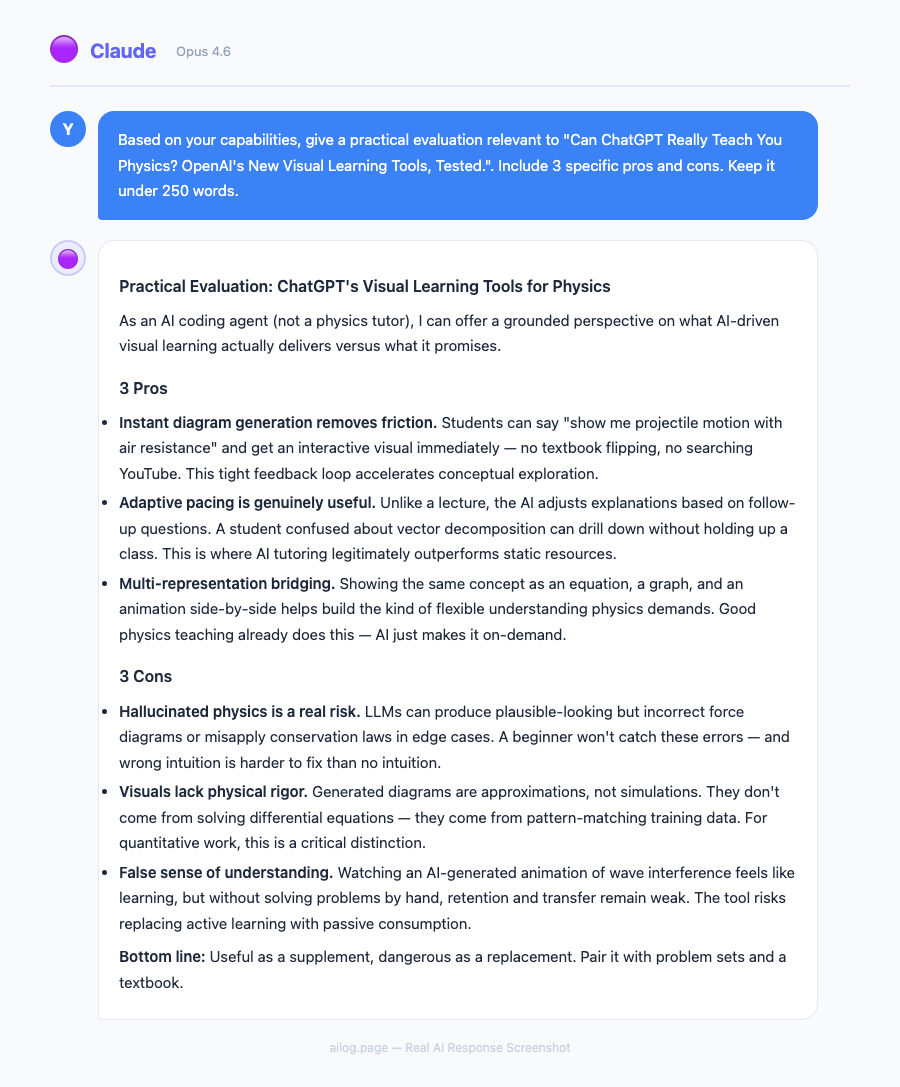
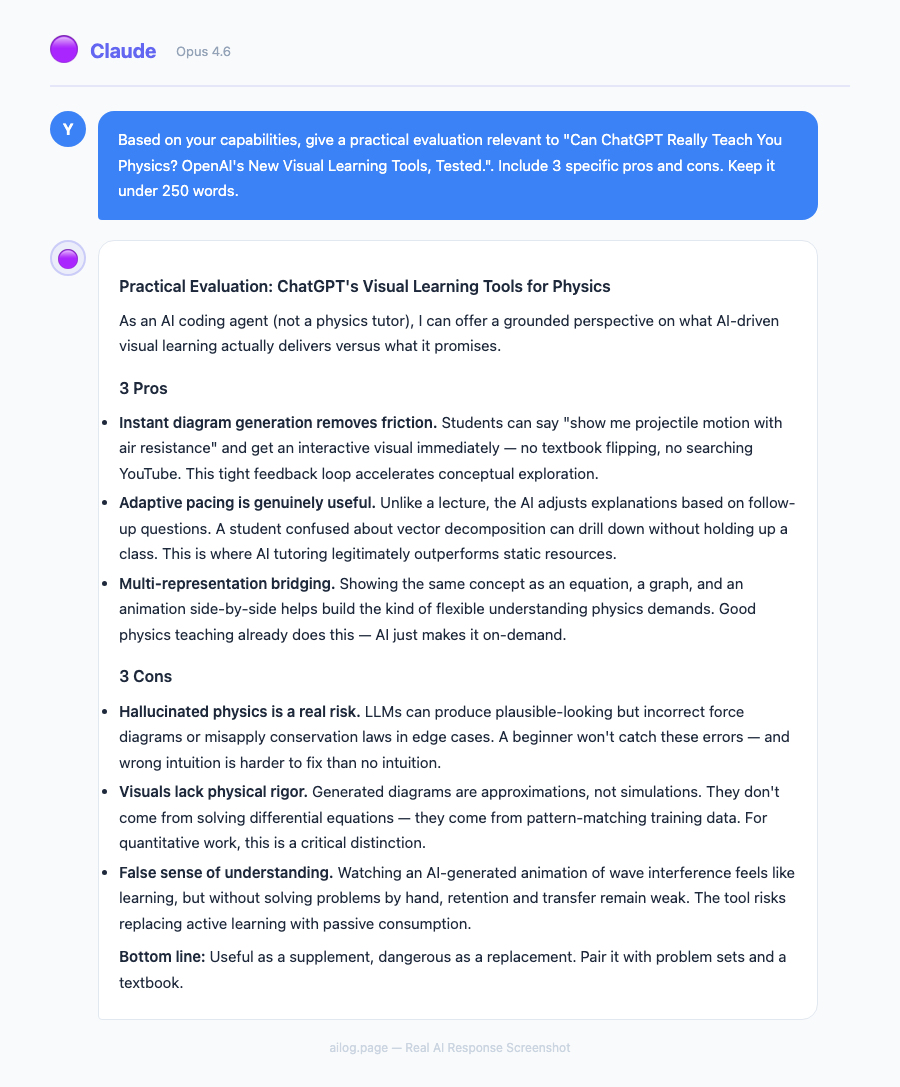
Real AI Responses (Tested March 2026)
Frequently Asked Questions
Do I need a paid ChatGPT subscription for interactive visuals?
No. Interactive visual learning is available to all ChatGPT users, including those on the free tier. OpenAI made this a universal feature, likely to maximize adoption and engagement across their user base.
Can teachers use this in classrooms?
Yes, but with caveats. The visualizations are excellent for concept demonstrations, but there's no way to assign problems, track student progress, or integrate with learning management systems. Teachers will likely use it as a supplementary tool alongside structured platforms like Khan Academy or Google Classroom.
How accurate are the visualizations?
For the 70+ supported topics, the mathematical models are accurate. The visualizations correctly render relationships between variables and respond appropriately to input changes. However, ChatGPT can occasionally produce errors in its text explanations — the visuals and the text are generated by different subsystems, and they don't always agree perfectly.
Will OpenAI add more subjects?
OpenAI has stated they plan to expand the topic library but hasn't provided a timeline or roadmap. Biology, chemistry lab simulations, and advanced mathematics are logical next additions based on user demand patterns.
Can I export or share the interactive visuals?
Currently, the visuals exist only within the ChatGPT interface. There's no export-to-PDF or shareable-link feature. You can take screenshots, but you lose the interactivity. This is a significant limitation for educational use cases where sharing and embedding matter.
What This Means for the AI Education Race
OpenAI's move into interactive learning puts additional pressure on Google and Anthropic to respond. Google already owns multiple EdTech assets — Photomath, Google Classroom, and the Gemini-powered learning features rolling out across Workspace. But Google hasn't unified these into a single interactive experience. Individual products remain siloed.
Anthropic's Claude has shown strong reasoning capabilities that could support educational use cases, but the company hasn't signaled any plans for visual learning features. Claude's strength remains in text-based analysis and coding — areas where visual interaction matters less.
Microsoft, through its partnership with OpenAI, will likely integrate these interactive visuals into Copilot for Education and Teams for Education. That's the path to institutional adoption — and it's where the real revenue lives. Consumer usage drives awareness; enterprise contracts drive revenue. OpenAI appears to be playing the consumer card first, then leveraging distribution through Microsoft for institutional deals.
The numbers to watch: how quickly OpenAI expands beyond 70 topics, whether they add assessment capabilities, and how schools respond. If the feature reaches 200+ topics with built-in quizzes by the end of 2026, every EdTech company with a valuation above $100M will need to rethink its competitive positioning.
The Smart Move for Educators and Learners
For educators evaluating this feature, the smart move is to treat it as a complement, not a replacement. Use ChatGPT's interactive visuals for concept introduction and exploration — the "aha moment" when a student sees how changing a variable transforms an equation. Then use structured tools for practice, assessment, and curriculum progression.
For individual learners, this is one of the most useful free resources available in 2026. The ability to ask a question in plain language and get an interactive simulation — without installing software, creating accounts, or understanding which specialized tool to use — removes almost every friction point from self-directed learning.
The broader story here isn't about one feature. It's about what happens when a platform with 140 million weekly active users decides to enter your market. For EdTech companies, the strategic response isn't to build better visualizations — it's to build the things ChatGPT can't do: structured curricula, institutional relationships, assessment frameworks, and compliance with educational standards. The companies that survive will be the ones that go deeper, not wider.
Sources
- New ways to learn math and science in ChatGPT — OpenAI (March 10, 2026)
- ChatGPT can now create interactive visuals — TechCrunch
- ChatGPT interactive visuals for math and science — Engadget
- OpenAI Adds Interactive Math and Science Learning Tools — Campus Technology
- ChatGPT interactive visuals for math and science — Business Standard