Perplexity AI: Can It Actually Replace Google Search?
Perplexity AI handles 780M queries monthly. Our in-depth review tests Pro Search, compares it to Google and ChatGPT, and reveals whether the $20/mo subscription is worth it.
Key Takeaways
- Perplexity AI processes 780 million queries monthly and is valued at $20 billion as of January 2026
- Every answer includes clickable source citations, making it genuinely useful for research and fact-checking
- Pro Search ($20/mo) delivers multi-step reasoning that neither Google nor ChatGPT Search can match for complex questions
- The free tier is surprisingly capable for casual users, but Pro unlocks the real power
- It won't fully replace Google for local searches, shopping, or quick navigational queries — but it dominates for research
Table of Contents
- What Is Perplexity AI and Why Does It Matter?
- How Perplexity AI Search Actually Works
- Pro Search: Where Perplexity Pulls Ahead
- Perplexity AI vs Google vs ChatGPT Search: Full Comparison
- Pricing: Free vs Pro — Is $20/Month Worth It?
- Spaces: Collaborative Research That Google Can't Touch
- The Legal Controversies You Should Know About
- Who Should (and Shouldn't) Use Perplexity
- FAQ
- The Verdict
What Is Perplexity AI and Why Does It Matter?
Perplexity AI has gone from a scrappy search startup to one of the most talked-about tools in tech. With 780 million monthly queries and a $20 billion valuation as of early 2026, it's no longer an experiment — it's a legitimate alternative to the way we've searched the web for two decades. I've been using it daily for the past several months, and it has fundamentally changed how I approach research, fact-checking, and even casual questions.
The core promise is simple: ask a question, get a direct answer with cited sources. No ten blue links. No SEO-optimized pages stuffed with ads before you find what you need. Just an answer, with numbered footnotes you can click to verify every claim.
That sounds like what Google's AI Overviews tries to do, and what ChatGPT Search also attempts. But having used all three extensively, I can tell you the execution is meaningfully different. Perplexity was built from day one as an answer engine, not a search engine with AI bolted on top.
Let me walk you through exactly how it works, where it excels, and where it still falls short.
How Perplexity AI Search Actually Works
When you type a query into Perplexity, here's what happens behind the scenes:
- Query interpretation: The AI parses your natural language question and determines what information you actually need
- Real-time web search: It searches the live web (not a static training dataset) to find relevant, current sources
- Source synthesis: It reads multiple sources, cross-references information, and synthesizes a coherent answer
- Citation mapping: Every factual claim in the response gets a numbered citation linked to its source
- Follow-up suggestions: It generates related questions you might want to explore next
This is fundamentally different from how Google works. Google indexes the web and ranks pages. You click through to pages and extract the answer yourself. Perplexity reads those pages for you and gives you the answer directly.
It's also different from ChatGPT's search feature, which was retrofitted onto a chatbot. ChatGPT Search sometimes feels like it's searching the web as an afterthought. Perplexity's entire architecture was designed around this flow.
The Citation System That Changes Everything
I want to emphasize this because it's Perplexity's killer feature: every answer cites its sources with clickable links. This isn't a "trust me, I'm AI" situation. When Perplexity tells you that a company's revenue hit a certain number, there's a little [1] or [2] next to it, and clicking it takes you to the original article.
I've fact-checked hundreds of Perplexity responses, and the citation accuracy is remarkably good. Not perfect — occasionally it'll misattribute a claim or cite a source that doesn't quite support the statement — but it's right about 90-95% of the time in my experience. That's a huge improvement over ChatGPT, which still hallucinates citations regularly.
The Models Behind the Curtain
Perplexity doesn't use a single AI model. It routes queries to different models depending on the complexity of your question. For simple factual queries, it uses faster, lighter models. For complex research questions (especially in Pro Search), it can use Claude, GPT-4, and its own fine-tuned models. This multi-model approach means you're getting the right tool for each job, rather than a one-size-fits-all solution.
Pro Search: Where Perplexity Pulls Ahead
The free version of Perplexity is solid for quick questions. But Pro Search is where things get genuinely impressive — and where the $20/month subscription justifies itself.
Multi-Step Reasoning
Pro Search doesn't just search once. It performs multi-step reasoning with follow-up searches. Ask a complex question like "What are the environmental implications of switching from lithium-ion to sodium-ion batteries at scale?" and Pro Search will:
- Search for current sodium-ion battery technology status
- Search for lithium-ion battery environmental impact data
- Search for sodium-ion manufacturing processes and their environmental footprint
- Cross-reference mining impact comparisons
- Synthesize all of this into a structured, cited answer
You can watch it work in real time — it shows you each search step, what it found, and how it's building toward the answer. This transparency is refreshing. You're not just getting a black-box response; you can see the reasoning chain.
Interactive Clarification
Pro Search also asks clarifying questions when your query is ambiguous. Ask about "best framework for my project" and it'll ask what kind of project, what language, what scale. This back-and-forth produces dramatically better results than a single-shot search.

File Upload and Analysis
Pro subscribers can upload PDFs, images, and documents for analysis. I've used this to upload research papers and ask Perplexity to summarize findings, compare methodologies across papers, or extract specific data points. It handles academic papers particularly well, understanding structure like abstracts, methodology sections, and results tables.
Perplexity AI vs Google vs ChatGPT Search: Full Comparison
I've spent weeks running the same queries across all three platforms to build a fair comparison. Here's what I found:
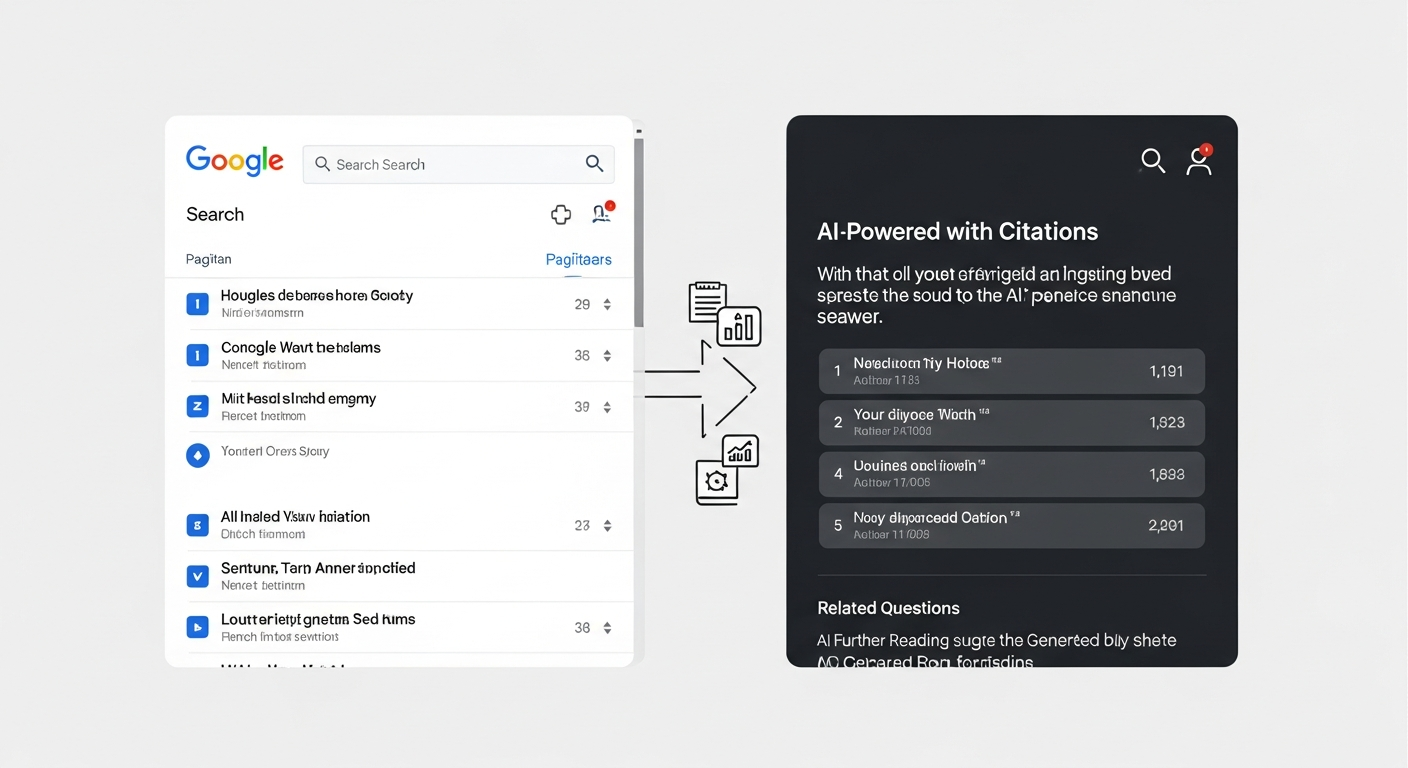
| Feature | Perplexity AI | Google (AI Overviews) | ChatGPT Search |
|---|---|---|---|
| Source Citations | Inline numbered citations on every claim | Links below AI Overview, loosely matched | Inline citations, but less consistent |
| Real-Time Data | Yes, live web search | Yes, with full Google index | Yes, via Bing integration |
| Multi-Step Research | Pro Search performs 5-10 sub-searches | Single-pass AI summary | Single search, sometimes follow-up |
| Follow-Up Questions | Natural conversation with context | Suggested searches (no conversation) | Full conversation with context |
| Local Search | Limited | Excellent (Maps, reviews, hours) | Basic |
| Shopping / Commerce | Basic product comparisons | Full Shopping integration | Limited |
| Code Generation | Good with documentation search | Basic (AI Overviews) | Excellent (full ChatGPT capabilities) |
| Hallucination Rate | Low (citations help verification) | Low-Medium | Medium |
| Price | Free / $20 mo (Pro) | Free | Free / $20 mo (Plus) |
| Ad-Free | Yes (for now) | No | Yes |
Where Perplexity Wins
Research and complex questions. This is where the gap is widest. When I need to understand a topic deeply — compare technologies, analyze trends, synthesize information from multiple domains — Perplexity Pro Search is in a different league. The multi-step reasoning, combined with cited sources, means I get a comprehensive answer I can trust and verify in minutes instead of the hours it would take to Google, click through articles, and piece together the picture myself.
Current events and breaking news. Perplexity's real-time web search is fast and thorough. When a major tech announcement drops, I can get a synthesized summary with source links within minutes. Google shows me the same information, but scattered across a dozen links I have to click through.
Technical documentation and debugging. When I'm trying to solve a coding problem or understand a technical concept, Perplexity often finds the right Stack Overflow answers, GitHub issues, and documentation pages faster than Google. It synthesizes across these sources too, so I get the solution rather than links to potential solutions.
Where Google Still Wins
Local search. "Best pizza near me" or "pharmacy open now" — Google's Maps integration, review aggregation, and real-time business data are unbeatable. Perplexity can answer these questions, but the experience isn't as rich or reliable.
Shopping and e-commerce. Google Shopping, price comparisons, product reviews, availability checks — this entire product category doesn't exist in Perplexity. If I'm buying something, I'm still going to Google.
Navigational queries. When I just want to go to a specific website or service, Google's "I'm Feeling Lucky" approach is faster. Perplexity will try to answer a question I didn't ask.
Where ChatGPT Search Fits
ChatGPT Search occupies an interesting middle ground. Its search capabilities are decent, but its real strength is that you're already inside ChatGPT's platform. If you're using ChatGPT for coding, writing, or analysis, having search integrated into that conversation is convenient. But as a standalone search tool, it doesn't match Perplexity's polish or citation quality. For a deeper comparison of the AI models themselves, check out my comparison of ChatGPT, Claude, and Gemini.
Pricing: Free vs Pro — Is $20/Month Worth It?
| Feature | Free Tier | Pro ($20/month) |
|---|---|---|
| Basic Search | Unlimited | Unlimited |
| Pro Search Queries | 5 per day | Unlimited |
| AI Models | Default model only | GPT-4o, Claude, Sonar Large |
| File Upload | 3 per day | Unlimited |
| Image Generation | Not available | DALL-E, Stable Diffusion |
| Spaces | Limited | Full access with collaboration |
| API Access | Not included | $5 monthly credit included |
My Honest Take on Value
If you search the web more than five times a day for anything beyond simple navigational queries, Pro is worth it. I was skeptical about paying $20/month for search when Google is free, but the time savings alone justify the cost for me.
Here's a concrete example: I was researching the current state of interoperability standards for AI tools. On Google, this would have taken me 30-45 minutes of clicking through articles, blog posts, and documentation pages. With Perplexity Pro Search, I had a comprehensive, cited summary in under 3 minutes. If you do this kind of research regularly, $20/month is a bargain.
That said, the free tier is genuinely useful. Five Pro Search queries per day covers casual use, and the unlimited basic search is good for straightforward questions. Start with the free tier and upgrade only if you hit the limits regularly.
Spaces: Collaborative Research That Google Can't Touch
Spaces is one of Perplexity's most underrated features. Think of it as a collaborative research workspace where you can:
- Save and organize searches into thematic collections
- Share collections with teammates for collaborative research
- Build on previous searches with the AI maintaining context across all searches in a Space
- Customize AI behavior with specific instructions or focus areas for each Space
I use Spaces heavily for ongoing projects. I have a Space for "AI Industry Trends" where every search I do about new models, funding rounds, or product launches gets saved and contextualized against previous searches. Over time, the Space becomes a living knowledge base.
For teams, this is even more powerful. A product team can share a Space for competitive research. A content team can use it for editorial planning. The collaborative aspect adds a dimension that no search engine has offered before.
The Legal Controversies You Should Know About
No honest review can skip this: Perplexity has significant legal issues. The New York Times and Forbes have both sued Perplexity for content scraping. The core allegation is that Perplexity's AI reads copyrighted articles, synthesizes the information, and presents it in a way that reduces traffic to the original publishers.
This is a real tension. The very thing that makes Perplexity useful — reading articles so you don't have to — is what publishers argue is copyright infringement. The citations help somewhat (they do link back to sources), but critics argue that most users never click through to the original article once they have the AI-generated summary.
Perplexity has responded by introducing a publisher revenue-sharing program and more prominent source attribution. Whether this is enough to satisfy publishers and the courts remains to be seen. As a user, you should be aware that the service you're benefiting from is built on a legal foundation that's still being tested.
The broader context matters too. Google has faced similar accusations with its AI Overviews, and the entire AI industry is navigating copyright questions. This isn't unique to Perplexity, but Perplexity is more exposed because its entire product is built on synthesizing others' content.
Who Should (and Shouldn't) Use Perplexity
Perplexity Is Great For:
- Researchers and analysts who need to synthesize information from multiple sources quickly
- Students working on papers or projects that require cited sources
- Developers debugging issues or learning new technologies
- Journalists and writers who need to fact-check claims and find primary sources
- Business professionals doing competitive research or market analysis
- Curious people who ask "why" and "how" more than "where" and "what time"
Stick With Google For:
- Local searches (restaurants, stores, services near you)
- Shopping (price comparisons, product availability, reviews)
- Quick navigation (going to a specific website)
- Image search (Google's image search is still the best)
- Highly personalized results (your Gmail, calendar, connected services)
The Real-World Usage Pattern
Most power users I know (myself included) don't pick one over the other. The realistic pattern is: Perplexity for research and complex questions, Google for everything else. My search behavior has shifted to roughly 60% Perplexity, 30% Google, and 10% direct website visits. A year ago, it was 90% Google.
Frequently Asked Questions
Is Perplexity AI free to use?
Yes, Perplexity offers a generous free tier with unlimited basic searches and 5 Pro Search queries per day. The free tier covers most casual use cases. Pro costs $20/month and unlocks unlimited Pro Search, multiple AI models, file uploads, and full Spaces access.
Is Perplexity AI more accurate than Google?
For factual research questions, Perplexity's accuracy is comparable to Google's, with the added benefit that every claim includes a clickable source citation. This makes it easier to verify accuracy. However, Perplexity can occasionally misinterpret sources or over-simplify nuanced topics. For local information (business hours, directions), Google is more reliable. Neither is perfect — always verify critical information.
Can Perplexity AI replace Google entirely?
Not yet. While Perplexity excels at research, complex questions, and information synthesis, Google still dominates local search, shopping, image search, and integration with the broader Google platform (Gmail, Calendar, Maps). Most realistic users will use both tools for different purposes. Perplexity handles about 780 million queries monthly — impressive growth, but still a fraction of Google's estimated 8.5 billion daily searches.
How does Perplexity AI handle privacy?
Perplexity stores your search history by default for personalization and improving results. You can delete individual searches or your entire history. Pro subscribers can enable "incognito mode" for searches that aren't stored. Perplexity's privacy policy states they may use anonymized query data to improve their models. If privacy is a priority, read their full policy and consider using incognito mode for sensitive searches.
Is the $20/month Pro plan worth it over ChatGPT Plus at the same price?
It depends on your primary use case. If your main need is research and information retrieval, Perplexity Pro is the better investment — its search and citation system is purpose-built for this. If you primarily need content generation, coding assistance, or creative writing, ChatGPT Plus offers more value. Many power users (including myself) subscribe to both. If you can only choose one, pick based on whether you search for information more often than you generate content.
The Verdict: Is Perplexity AI Really Better Than Google Search?
After months of daily use, here's my honest assessment: Perplexity AI is better than Google for research and complex questions, but it doesn't replace Google entirely.
The company's growth to 780 million monthly queries and $500 million projected ARR for 2026 tells you this isn't just hype. People are finding genuine value. The 4.4 million monthly searches for "Perplexity AI" itself shows how much interest there is.
What Perplexity does well, it does exceptionally well. The citation system is the gold standard for AI-powered search. Pro Search's multi-step reasoning is genuinely useful for deep research. Spaces adds a collaborative dimension that nothing else offers.
But it has real limitations. Local search is weak. Shopping doesn't exist. The legal controversies around content scraping are legitimate concerns. And while the free tier is generous, you need to pay $20/month to unlock the features that make Perplexity truly stand out.
My recommendation: start with the free tier today. Use it for your next research task instead of Google. You'll know within a week whether it fits your workflow. If you find yourself hitting the 5 Pro Search daily limit regularly, the upgrade pays for itself in time saved.
The search industry is being reshaped by AI, and Perplexity is at the forefront of that transformation. Whether Google catches up with AI Overviews, whether the legal challenges force changes to the model, or whether a competitor emerges with something better — those are open questions. But right now, in March 2026, Perplexity AI is the best research-focused search tool available. That's not better than Google at everything. But for the things it does well, nothing else comes close.
This review reflects my personal experience using Perplexity AI daily from late 2025 through March 2026. Perplexity AI is a rapidly evolving product — features, pricing, and capabilities may change. Last updated: March 2026.
Sources
- DemandSage — Perplexity AI Statistics 2026: Active Users and Revenue
- TechCrunch — Perplexity Reportedly Raised $200M at $20B Valuation
- WebProNews — Perplexity AI Targeting $500 Million in Revenue by 2026
- TechCrunch — The New York Times Sues Perplexity for Copyright Infringement
- DemandSage — Google Search Statistics 2026
- Perplexity AI — Privacy Policy